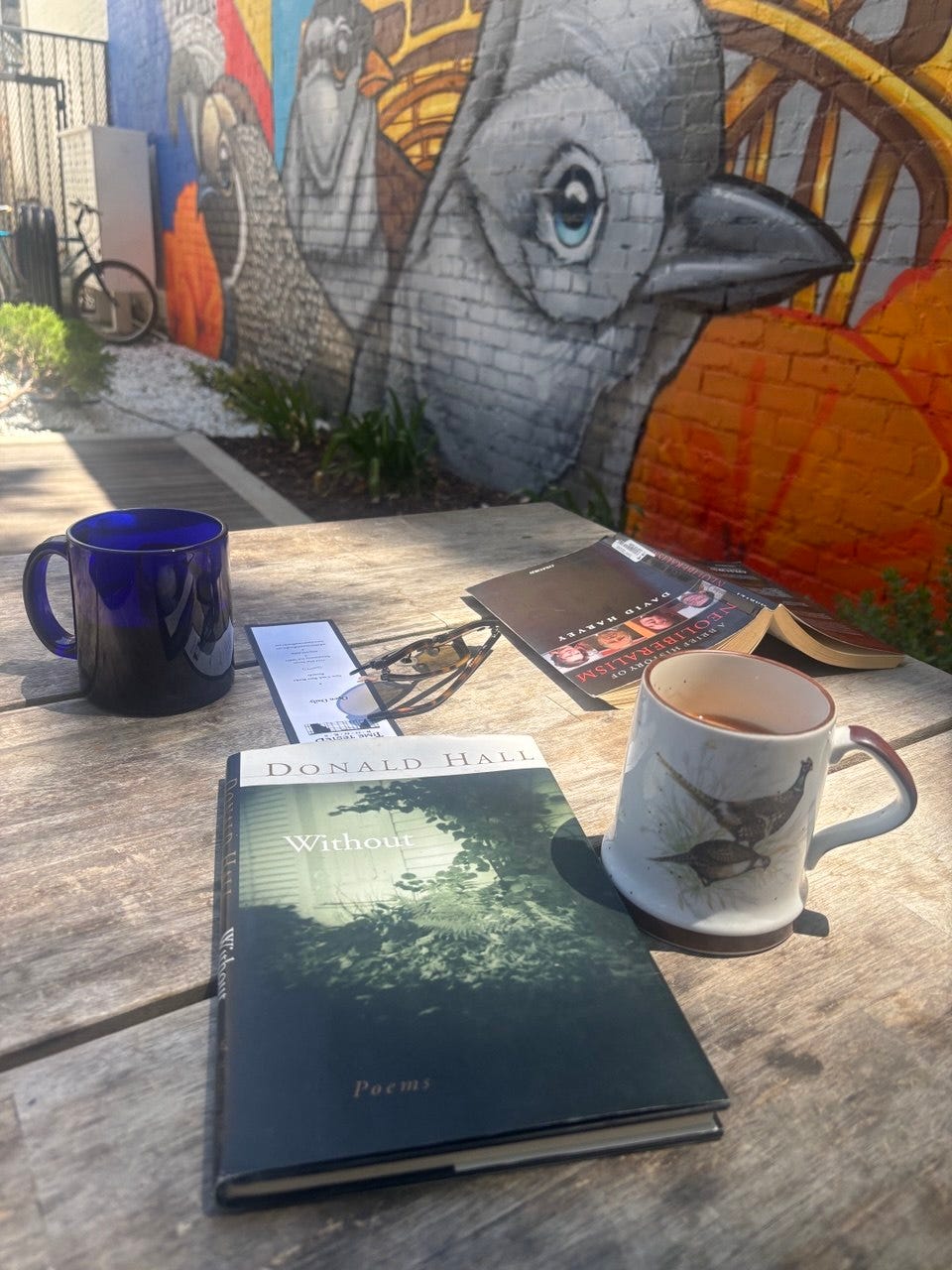
Love against your better instincts
Donald Hall's "Without" might be the best account of loving and losing a partner for life. It'll make you laugh and mostly, cry. It'll make you a better lover.

Everyone has rules about who you should love or marry. He has to make enough money. She has to get along with your mother, want enough children, or whatever else men desire. The longtime lovers I know who love each other rarely meet all the requirements.
Donald Hall and Jane Kenyon first met when Hall was her poetry professor at the University of Michigan. Without endorsing professor/student relationships, their rule-breaking turned out okay. Hall outlived Kenyon by nearly twenty years. He had always worried about leaving Kenyon a widow in her 40s, and the irony of the reversal was not lost on him.
I loved to turn up in your poems.
I imagined those you’d make
after I died; I regretted
I wouldn’t be able to read them.
Donald Hall: Midwinter Letter
The collection begins with “Her Long Illness,” introducing Kenyon’s cancer treatment as the main subject of the book. Then turns with his poem “Without” to a dissection of his grief, not at losing but at having lost. No part of his life is left untouched by Kenyon. It’s only natural she would become the main subject of his writing too.
Hall offers the delightfully detailed attention to Jane. Remembering her bread “so honest” it turned blue, her poems written from behind “the cave” of her long hair, and her humor even in the cancer ward.
It’s a painful read with lines that get stuck in your teeth. I picked at them for days.
It dropped to thirty-eight below—
with no furnace, no storm
windows or insulation.
We sat reading or writing
in our two big chairs, either
side of the Glenwood,
and made love on the floor
with the stove open and roaring.
You were twenty-eight.
If someone had told us then
you would die in nineteen years,
would it have sounded
like almost enough time?
Donald Hall: Letter in the New Year
I would feel lucky to be remembered half so well and with so much tenderness for my oddities and habits. I am lucky to have someone who will curl up on our long couch with a book. Pausing to chit-chat, reflect, but mostly building a comfortable, thoughtful silence.
Many are not so lucky. Young people come together and break up like flashes of lightning. That’s nothing new.
What’s remarkable is Kenyon and Hall's enduring partnership. They separated only after the emaciating indignities of cancer treatment and recurrence. Hall’s loss is deeper than youth’s false starts. Hall’s grief only emphasizes the preciousness of his life with Jane.
A married friend told me recently he couldn’t imagine starting over with someone else. Reflecting on his wild and misspent youth, he admits he didn’t understand how good life could be. They too broke rules, dated a little old or young, had messy separations, before finally uniting for good.
A happy marriage is a miracle. A miserable one is an affliction.
That’s what makes Without so special. It’s a collection that could only be written by a faithful husband who paid attention – for decades. It’s hard to imagine how intertwined two lives can become after twenty years. Only two years and change into life with my boyfriend, it’s hard to picture my days without him. I imagine the weight of twenty Christmases, losses shared, victories won, and friends made.
I don’t envy Hall’s loss. That would be insane. But I respect the life Donald and Jane built together. I admire his faithfulness to love even in death. I know I’d be lucky to feel such pain; anything less is insignificant by comparison.